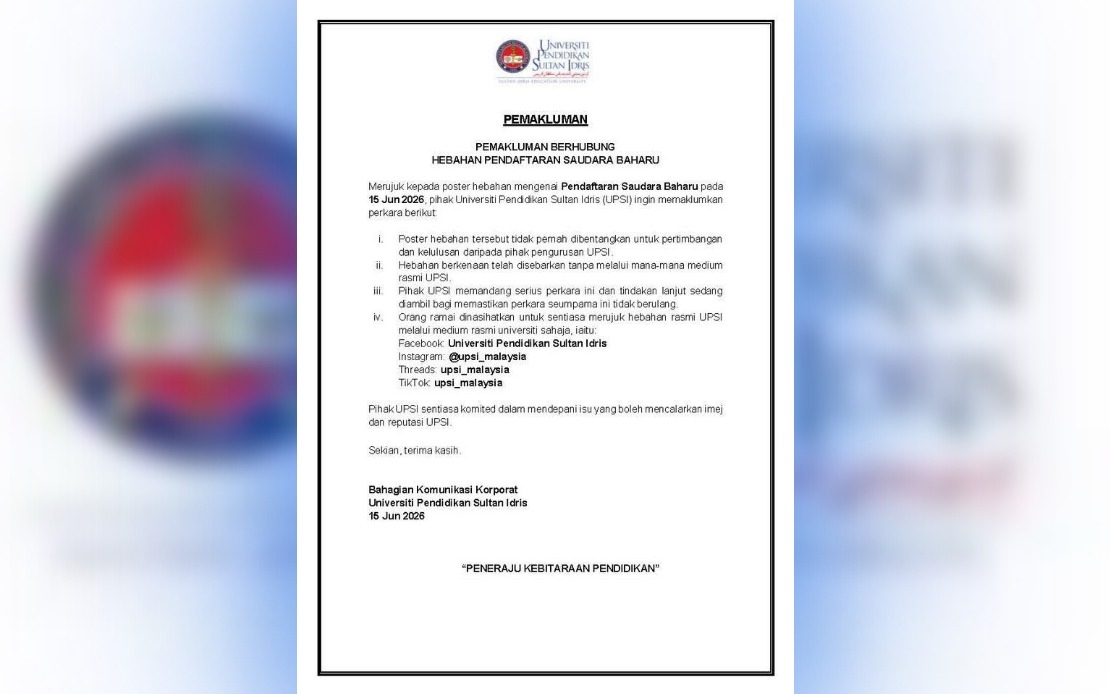
Universiti Pendidikan Sultan Idris (UPSI) moved swiftly to distance itself from a controversial poster about registering 'saudara baharu'—individuals who have converted to Islam—that circulated widely across social media platforms in mid-June. The Kuala Lumpur-based institution issued a public clarification through its official accounts, firmly denying any institutional involvement in the document's creation or distribution.
The poster, dated June 15, had gained significant traction online before triggering alarm bells within UPSI's administration. The university's response came through measured statements on its social media channels, emphasizing that the material never underwent formal review or received explicit approval from senior leadership. This sequence of events highlights growing concerns about unauthorized content being attributed to Malaysian educational institutions without proper verification.
UPSI's statement underscored a critical procedural breach: the poster was disseminated entirely outside official university communication pathways. Rather than emanating from UPSI's legitimate announcement channels—which typically include the institution's verified social media profiles, official website, or formal institutional communications—the material gained momentum through unofficial means. This distinction matters considerably, as it suggests someone may have created or shared the content while falsely implying institutional endorsement.
The university characterized its response as reflecting a serious stance toward protecting institutional integrity. Officials indicated that further investigation would follow to identify how the poster emerged and circulated, with measures planned to prevent similar incidents. This commitment extends beyond reactive damage control; UPSI framed the issue within broader institutional governance, positioning reputation management as a core administrative function.
For the Malaysian public and prospective students, UPSI's clarification carries practical significance. The university explicitly advised citizens to verify announcements exclusively through recognized official channels rather than relying on content circulating through social platforms. This guidance reflects a widening problem across Southeast Asian institutions: the ease with which misinformation or unauthorized communications can attach themselves to credible organizations' names and gain legitimacy through simple attribution.
The incident reveals vulnerabilities in how educational institutions communicate with external audiences in an era dominated by rapid information sharing. Posters and promotional materials can be quickly replicated and shared with minimal friction, creating scenarios where unofficial content becomes conflated with institutional positions. UPSI's response strategy—immediate denial combined with public guidance on distinguishing authentic communications—represents a standard damage-limitation approach, though the underlying structural challenge persists.
Background context matters here. Malaysia's education sector has expanded significantly in recent decades, with universities like UPSI playing prominent roles in teacher training and national development. Any reputational damage to such institutions carries implications beyond individual campuses, potentially affecting public confidence in Malaysian higher education more broadly. This makes swift, transparent communication essential when controversies emerge.
The 'mualaf' registration topic itself touches on sensitive religious and social dimensions within Malaysian society. Conversion to Islam involves formal legal registration processes managed through Islamic religious authorities rather than educational institutions. That a poster about this topic emerged ostensibly bearing UPSI's name suggests either deliberate misrepresentation or careless attribution. Either scenario warranted the institution's decisive public correction.
From an institutional governance perspective, this episode underscores why Malaysian universities increasingly invest in social media monitoring and crisis communication protocols. The speed with which unvetted content can achieve viral reach means universities must respond quickly once problematic material appears, establishing accurate narratives before misinformation solidifies in public consciousness. UPSI's handling demonstrated this principle in action.
The broader implication for Malaysian readers involves media literacy and verification habits. UPSI's counsel to consult official channels before accepting institutional claims represents sensible guidance applicable across numerous contexts. As social media continues reshaping information distribution, distinguishing between verified institutional communications and user-generated or third-party content becomes increasingly important for maintaining accurate understanding of events and organizational positions.
Looking forward, this incident likely prompted UPSI to review internal communication protocols and perhaps enhance digital security measures protecting institutional branding. Similar Malaysian universities have begun implementing verification systems for official announcements, making it easier for audiences to distinguish authentic communications from imitations or misattributions. Such protective measures help safeguard institutional credibility in an environment where attribution remains deceptively simple but consequences prove substantial.